
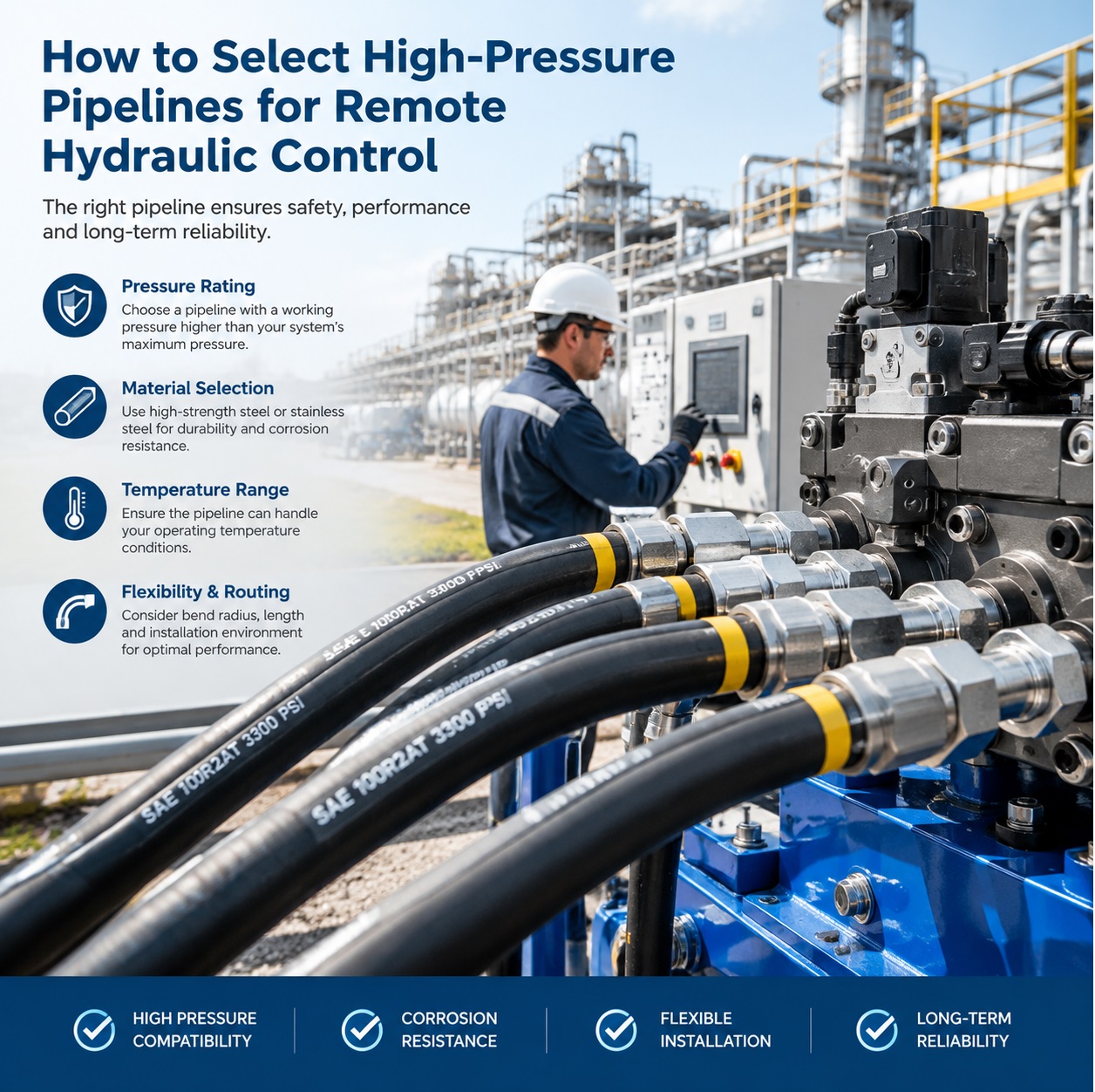
 A burst hydraulic line three hundred meters from the control cabin doesn’t announce itself politely. It bleeds pressure, stalls the actuator, and turns a routine operation into an unplanned shutdown. Remote hydraulic control systems live or die by the pipeline that carries the pressure, and choosing that pipeline is where most projects either get it right or spend the next decade paying for it.
Here’s what actually matters when you’re specifying high-pressure lines for remote control applications.
Start With the Pressure You’ll Never See on the Gauge
Everyone quotes the working pressure. Fewer people talk about surge pressure, and that’s where failures hide. When a valve slams shut or an actuator stalls, pressure spikes can hit two to four times the steady-state operating pressure in milliseconds. A line rated at 350 bar working pressure that sees 900 bar spikes twice a day will not last.
So the first rule: select for peak pressure, not nominal pressure. Apply a safety factor of at least 4:1 on the burst rating for static installations, and higher if the system cycles frequently or experiences rapid valve actuation. If your supplier only talks about working pressure and never mentions burst or proof pressure, that’s a red flag worth heeding.
Material Choice: Stainless Isn’t Automatically the Answer
The default reflex is to reach for 316 stainless steel and call it done. It’s a reasonable starting point for corrosive environments, but it’s not universal.
Carbon steel with proper coating works well in dry, controlled industrial settings and costs significantly less. For offshore platforms or chemical plants, duplex stainless or even super duplex grades hold up better against chloride stress corrosion cracking, which ordinary 316 is prone to in warm, salty conditions.
Then there’s the question of tubing versus hose. Rigid tubing handles higher pressures and dissipates heat better, but it can’t absorb vibration or accommodate movement between connection points. Flexible hose tolerates misalignment and thermal expansion, but has a shorter service life under continuous high pressure and needs more frequent inspection. Many remote control systems use a hybrid: rigid runs for the long straight sections, flexible jumpers at the ends where movement occurs.
Wall Thickness and the Inner Diameter Trade-Off
Thicker walls handle more pressure. That part is simple. What’s less obvious is that wall thickness eats into the inner diameter, and inner diameter determines flow rate and response time.
In a remote hydraulic control line running several hundred meters, pressure drop along the length becomes a real design constraint. A line that’s too narrow creates sluggish response, and sluggish response defeats the purpose of remote control. Run the pressure drop calculation for your actual fluid viscosity and flow demand before locking in a size. If the numbers are close, go one size up. The cost difference is trivial compared to a system that responds half a second too slow.
Fittings and Connections: Where Most Leaks Begin
The pipeline itself is rarely the failure point. The joints are.
JIC, NPT, BSP, SAE flange, cone and thread, medium pressure bite-type fittings. Each has a pressure ceiling and a correct application. NPT threads seal on the threads themselves and are notorious for loosening under vibration. JIC and SAE flange connections seal on a seat or face and handle vibration far better.
For high-pressure remote lines, avoid threaded pipe connections wherever possible. Use cone and thread or flanged connections rated for the full system pressure. And torque every fitting to spec with a calibrated wrench. Hand-tight plus a quarter turn is how leaks are born.
Environmental Reality Check
A pipeline that performs flawlessly in a temperature-controlled test bay can fail in weeks when deployed in the field.
Temperature swings cause expansion and contraction. UV exposure degrades polymer hoses and some coatings. Salt spray attacks unprotected carbon steel. Vibration fatigues fittings and work-hardens tubing at bend points. If the line runs through an area with abrasive dust or chemical splash, the outer surface needs protection too.
Ask yourself where this line will physically sit for the next ten to twenty years. Then specify for that place, not for the ideal conditions in a catalog.
Certifications and Documentation
For any system where failure means safety risk or major financial loss, insist on material traceability. Mill certificates, pressure test reports, and third-party inspection documents are not bureaucracy. They’re your only proof that the pipe in your hand matches the pipe you ordered.
Standards like ISO 10763, SAE J514, and EN 853 exist for a reason. A supplier who can’t tell you which standard their product meets, or who waves off the question, is a supplier you shouldn’t be buying from.
The Supplier Question
Price per meter is the easiest thing to compare and the least useful. What matters more is whether the supplier understands your application, stocks the fittings that match the tube, and can provide technical support when something doesn’t fit the way the drawing said it would.
A cheap line that arrives without matching fittings, correct documentation, or anyone to call when it leaks is not cheap. It’s expensive with a delay.
Final Word
Selecting high-pressure pipelines for remote hydraulic control is not a catalog exercise. It’s a system design decision that touches pressure dynamics, material science, installation practice, and long-term maintenance. Get the pressure rating right, match the material to the environment, size for flow not just strength, and treat every fitting as a potential failure point. Do that, and the line disappears into the background where it belongs, quietly doing its job for years while you focus on everything else.