
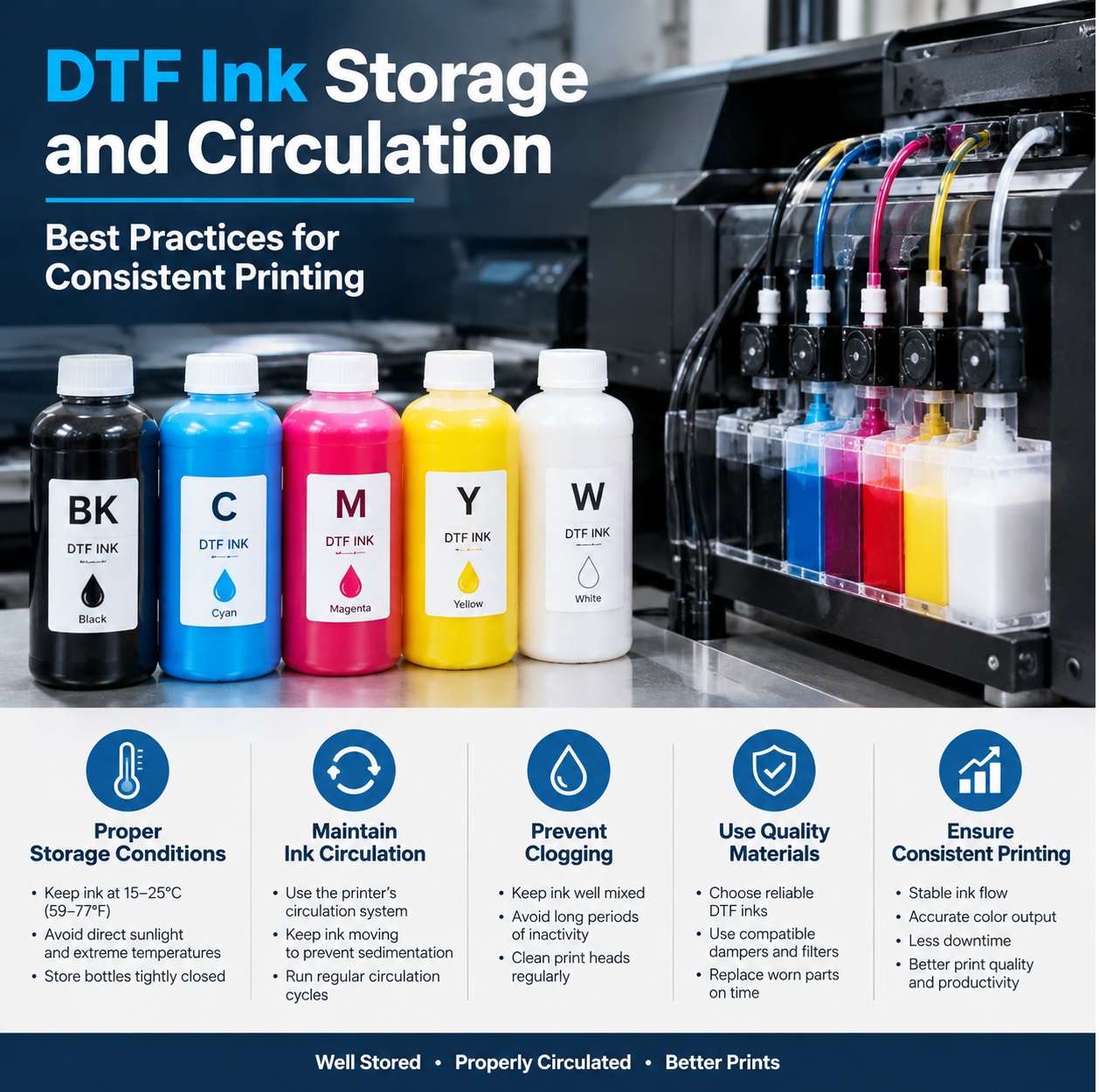
 A shelf full of DTF ink is not a warehouse. It is a chemistry set with a clock attached. Pigment particles settle. Resins separate. White ink turns into a thick, stubborn layer at the bottom of the bottle. Then a customer orders 200 transfers with a logo that has a specific red, and your printer decides to print a slightly different red. The culprit is rarely the RIP profile alone. It is usually how the ink was stored, how long it sat, and whether it was circulated before it went into the lines.
If you sell DTF transfers, consistency is the product. Not just the film, not just the powder, not just the press. The repeatable color, opacity, stretch, and wash durability come from ink that behaves the same way every shift. That starts long before the first print head fires.
WHY INK HANDLING BEATS INK SPECS
A spec sheet can tell you viscosity, particle size, and cure temperature. It cannot tell you whether the bottle sat in a hot delivery van for three days or whether someone topped off a white ink tank with a different lot. DTF ink is a dispersion, not a simple dye. Pigment particles are suspended in a liquid carrier. Left alone, they settle. Exposed to heat, they can agglomerate. Exposed to cold, they can separate and not fully recombine. Exposed to air and dust, they can contaminate.
The printer is only as consistent as the ink you feed it. So treat ink storage and circulation as production equipment, not backroom inventory.
STORAGE: CONTROL THE FOUR ENEMIES
The four enemies are heat, cold, light, and contamination. Keep unopened and opened DTF ink in a dedicated cabinet or climate-controlled room. Aim for a stable temperature between 18°C and 25°C (65°F to 77°F). Avoid windows, radiators, compressors, and loading dock doors that bake in summer and freeze in winter.
Humidity matters too. High humidity can introduce moisture when bottles are opened. Low humidity increases static and dust. A range of 40% to 60% relative humidity is a practical target for most shops.
Keep containers sealed with original caps. Do not store ink in open cups, unlabeled squeeze bottles, or random jugs. Label everything with the lot number, date opened, and ink type. Use FIFO or FEFO: first in, first out; first expired, first out. If you buy in bulk, split larger containers into smaller, clean, amber or opaque bottles only when the manufacturer allows it. Never mix old ink with new ink to stretch a batch. That is how you create a color shift you cannot diagnose.
Cold ink needs time. If a shipment arrives cold, let it sit sealed at room temperature for 12 to 24 hours before opening. Opening cold ink can pull condensation into the bottle. That tiny bit of water can throw off viscosity and cure.
CIRCULATION: KEEP PIGMENT MOVING
Storage keeps ink alive. Circulation keeps it printable. DTF ink, especially white, needs gentle, regular agitation. If your printer has a circulation system, use it on the manufacturer’s schedule. For many white ink systems, that means a daily circulation cycle and a nozzle check before production. If the machine sits idle for a weekend, run the cycle before you print a single transfer.
For bottles and bulk reservoirs, follow the ink maker’s instructions. Some inks want a gentle roll. Some want a short shake. Some want a mechanical stirrer. Violent shaking can whip air into the ink, which causes foaming, poor flow, and inconsistent density. Air bubbles in the line are not just annoying. They can create missing nozzles and weak patches in the transfer.
Keep lines, dampers, and print heads primed. Do not let white ink sit in the line for days without movement. If you are not printing, run a daily maintenance print or a small purge. A tiny daily print costs less than a clogged head and a ruined rush order.
WHITE INK NEEDS A DIFFERENT RHYTHM
White DTF ink is the diva of the ink set. It has heavier pigment loading, and it settles faster. It is also the ink that determines opacity, which is the first thing customers notice. Treat white ink like a shift worker who needs to stretch every few hours.
If your production runs all day, circulate white ink before each shift and during long pauses. If you run one shift, circulate at startup and before shutdown. If you run sporadically, consider a bulk system with automated circulation or choose an ink and printer combination designed for intermittent use. The wrong setup will punish you with clogged nozzles and chalky transfers.
Never judge white ink by the bottle. Judge it by the first nozzle check, the first print, and the opacity on film. If the white looks weak, do not immediately increase ink limits. Check circulation, temperature, and lot consistency first.
THE DAILY, WEEKLY, MONTHLY ROUTINE
Daily: check temperatures. Shake or roll ink bottles according to the supplier. Run the printer’s circulation cycle. Print a nozzle check. Inspect white ink lines for separation or air gaps. Log any issues.
Weekly: rotate stock. Check opened bottles against the FIFO schedule. Clean capping station, wiper, and surrounding areas. Inspect filters if your system uses them. Review print quality against a standard test file.
Monthly: audit lot numbers. Check expiration dates. Deep clean according to the printer manual. Review ink usage versus sales so you are not overstocking. Overstocking feels safe, but old ink is not safe. It is a hidden defect.
WHEN TO STOP USING A BATCH
Stop using ink if you see sediment that does not disperse after proper agitation, a gel-like texture, a strong odor change, or a color shift that cannot be corrected with a profile. Stop if the bottle has been open beyond the manufacturer’s recommended window. Stop if the lot has caused multiple unexplained clogs or poor adhesion.
Do not filter and reuse ink unless the manufacturer explicitly says it is safe. Filtering can remove dispersants and change the chemistry. Do not mix lots to solve a shortage unless you test a small batch first and label the blend. A rushed blend can cost you a customer.
TURN INK DISCIPLINE INTO A SELLING POINT
Here is the marketing part, and it is not fluff. Consistency is a promise. When a customer reorders the same transfer, they expect the same red, the same white, the same soft hand, and the same wash result. If your shop can deliver that month after month, you can charge for reliability. You can take on bigger accounts. You can reduce remakes, rush fees, and angry emails.
Ink storage and circulation are not glamorous. They are a competitive advantage. A clean, labeled, climate-controlled ink cabinet and a daily circulation routine tell your team that quality is systematic, not lucky. They also tell your customers, even if they never see the back room, that their order is not a gamble.
Work with a supplier who gives you lot traceability, storage specs, and circulation guidance in writing. That support is worth as much as the ink itself when you are trying to promise the same print every single time.
If you want consistent DTF printing, start with the bottle before the print head. Store it like chemistry. Circulate it like production. Track it like money. The prints will follow.